Hookbaits: when color makes all the difference
- Christophe Courtois

- 27 nov. 2025
- 3 min de lecture
The sun barely breaks through the morning mist. Three lines lie in the same spot, same rig , same distance, same bait. Only the color of the hookbait differs. An hour later, only one rod goes off—the one rigged with a bright yellow. This kind of scene, well known to observant carp anglers , reveals an often overlooked truth: color changes everything. But why can a simple shade of color tip the scales in a fishing session ? The answer lies in a clever mix of visual biology, the physics of light, and strategic adaptation.

1. Seeing Like a Carp: The Science Behind Perception
The work of Arthur D. Lythgoe (University of Bristol, 1979) and Douglas M. Guthrie (Marine Biological Association, 1983) has greatly contributed to understanding the underwater vision of fish.

The common carp ( Cyprinus carpio ), like many benthic species, possesses cones sensitive to green and blue , and to a lesser extent to red. But underwater, the perception of these colors varies according to depth , turbidity , and the nature of the seabed .

Studies conducted by Bowmaker & Kunz (1987, Journal of Comparative Physiology) showed that carp react more strongly to light contrasts than to pure colors. Therefore, it is not just the hue that attracts them, but the overall visual signal , influenced by reflection, clarity, and the dynamics of the environment.
In summary:
Carp are very good at distinguishing between light and dark contrasts.
They see better in the green-blue spectrum than in red .
Their sensitivity drops sharply in deep or murky areas.
2. The role of light, turbidity, and background
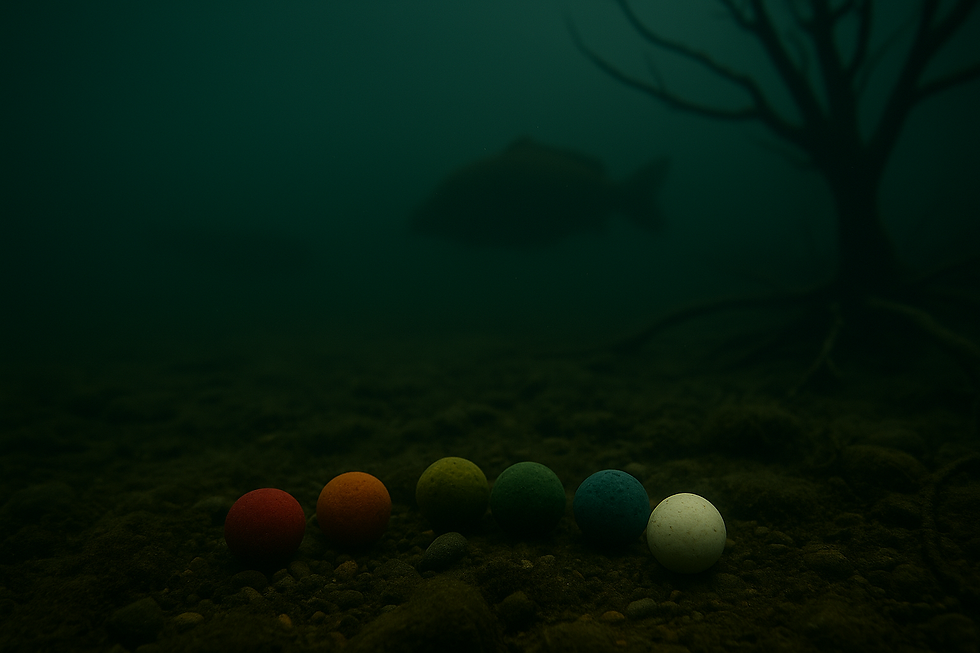
Sunlight undergoes selective absorption in water: each wavelength is filtered differently.
In clear water, light penetrates deeper, preserving cool tones.
In water with high mineral content, suspended particles diffuse and disperse the colors, reducing visibility. The bottom (sand, gravel, mud, algae) acts like a mirror or a filter : it can enhance or neutralize certain colors.
It is this unique combination of parameters — light intensity, clarity, background — that determines the visual “reading” of a hookbait (bait on the hook) by the carp.
3. Depth and light spectrum: what science tells us
Jerlov 's studies (1976) on the penetration of light into water established a simple law: the deeper you go, the more the warm hues disappear.

4. Adapt your color strategy

This chart is not just a theoretical guide: it reflects the reality of perception . In deep water or in tinted water, cool and light colors (white, fluorescent yellow, pale blue) retain a strong power of attraction. Conversely, in shallow areas and in clear water, warm and natural hues (red, orange, light brown) appear more natural and reassuring.
Another factor often overlooked: the weather .
In overcast weather or in the evening, blue light dominates, enhancing the effectiveness of light-colored baits.
In full sunlight, harsh reflections can frighten carp — a matte or “powdery” tone then becomes more effective.
5. Field experience

Testing several colors simultaneously in the same area remains the most reliable method for understanding fish reactions. During some sessions, a simple color change has turned the tide of fishing: a white boilie that was previously ignored suddenly becoming irresistible after a cloud passed, or an orange hue regaining its effectiveness after the bottom was stirred up. Every body of water, every season, every hour has its own unique color profile . It's up to the angler to decipher it.
6. Final Reflection
The color of a hookbait is not simply an aesthetic choice. It's a vector of sensory communication , a precise signal in a world where light dictates perception. Understanding this interaction between color, depth, and carp behavior gives scientific meaning to the angler's intuition.
"It's not the color that captures the fish, but the way it asserts itself in its world."