Fishing or "the philosophy of happiness" - Chris Yates
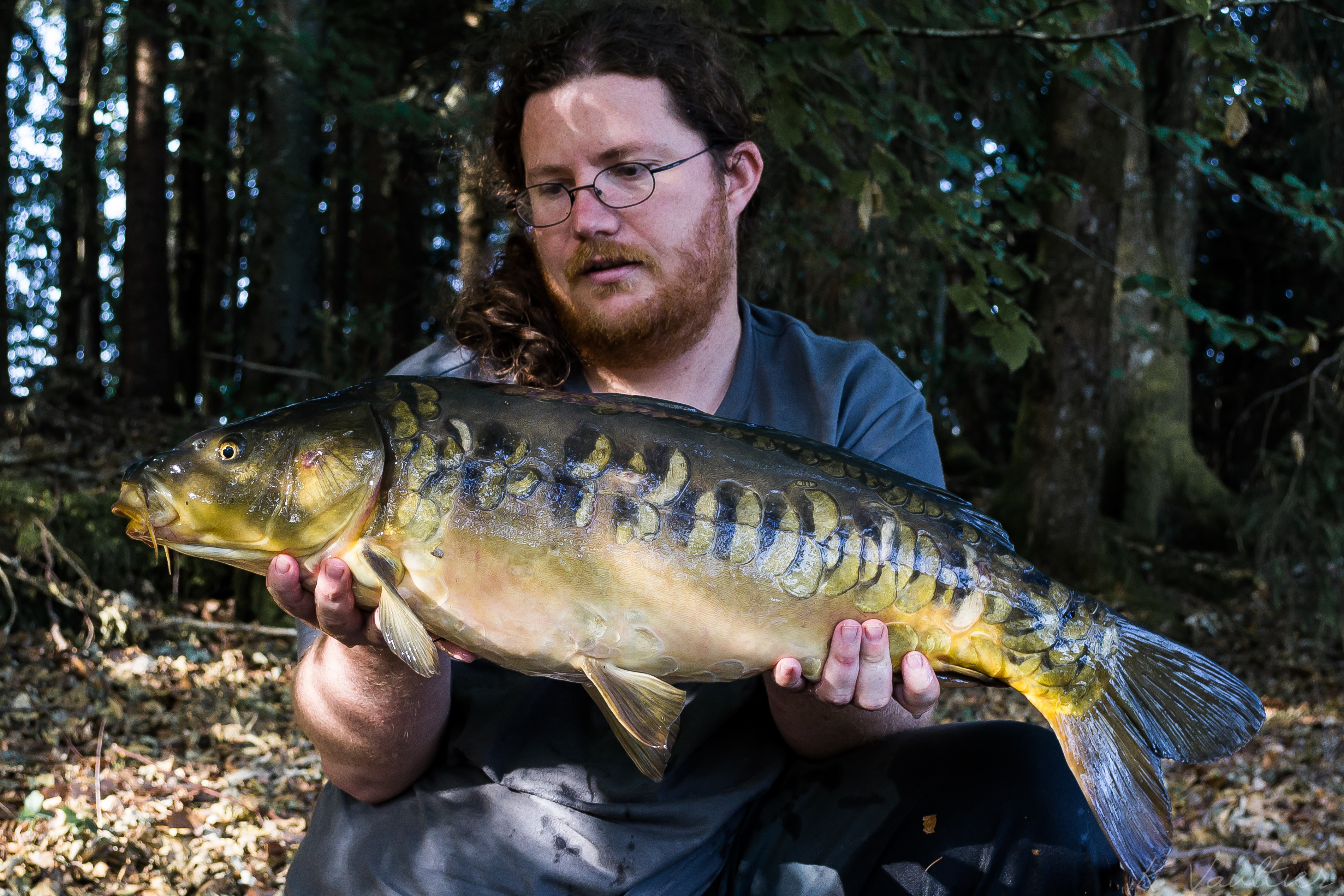
Although fishing is mostly done on the water's edge, I often extend my adventures by exploring the banks of lakes and rivers around the world … through books. Fishing literature thus prolongs my outings, and recently I was captivated by Chris Yates 's *Fishing or the Philosophy of Happiness* , a book I immersed myself in and couldn't seem to resurface. As the publisher's description aptly summarizes: "Immersing oneself in this book is a delight that rivals the pleasure of fishing itself."

Before discussing the book, let's take a moment to consider its author, Christopher Yates . A fisherman, photographer, writer, and avid tea enthusiast, born on April 19, 1948, he occupies a unique place in the world of British fishing. He has made his mark as much through his catches as through his contemplative lifestyle and almost artistic approach to fishing. In 1980, he made history by catching "The Bishop ," a 51 lb 6 oz (just over 23 kg) mirror carp, a British record at the time, in the legendary Redmire Pool .

Chris Yates is also known for his numerous books, including Casting at the Sun, Four Seasons, and How to Fish. He was also co-editor of Waterlog magazine and has been a prominent figure in radio and television, notably with Reading the Water on the BBC and the series A Passion for
Angling, broadcast in 1993 on BBC2.
He's an atypical fisherman who sees fishing as much more than just the pursuit of a catch. For him, it's a meditative experience, a total immersion in the landscape, the water, the seasons, and the behavior of the fish. He favors traditional equipment, convinced that simplicity—a bamboo rod and a thermos of tea—fosters a more authentic connection with nature.
A world away from the competitive fisherman, Chris Yates embodies a different relationship with water and fish: a quiet poetry, sensitive writing, a sustainable vision. Fisherman, observer, and storyteller, he invites us to rethink our relationship with nature through his books and his own way of life.
In Fishing , or the Philosophy of Happiness , Yates doesn't seek to teach a technique. His project is quite different: as the seasons unfold, he recounts a way of being, a philosophy born by the water's edge. From the very first pages, we understand that for him, fishing is not simply about catching a fish, but about entering a particular state of being, characterized by observation, calm, and openness to the world. He describes those hours spent sitting by a river or lake, attentive to the slightest movements of the water, the changes in the wind, the reflections of the light. Fishing time then becomes a suspended time, almost outside the modern world, where one savors simplicity: a wicker basket, a rod, a reel, a hot cup of tea.
An essential part of the charm
Yates also reflects on his fishing history, particularly his relationship with carp. In his youth, he was passionate about them, spending entire nights stalking them, culminating in the capture of "The Bishop." Carp was his favorite fish for a long time, the one that gave him the strongest thrills. But, over time, he saw this type of fishing transform. What was once a romantic and uncertain adventure for him became a discipline saturated with equipment, overly structured, and overly technological. This escalation, in his opinion, has eliminated an essential part of its charm: the unexpected, the silence, the art of waiting without certainty.

His quest for authenticity
It was at this point that he mentioned his departure from carp fishing: not because he lost his love for the fish, but because modern fishing practices no longer resonated with his quest for authenticity and lacked a certain poetry. Faced with this realization, he turned to more modest and intimate forms of fishing: angling for chub in small rivers, targeting large perch, or simply the pleasure of watching a float bob. With just one rod, a few baits, and an almost childlike approach, he rediscovered a freedom he no longer felt while stalking carp.
For him, being in harmony with the moment has become essential. Whether he returns empty-handed or not, each outing is a unique experience. The pleasure no longer lies in the catch itself, but in the moment, in being present by the water's edge, in the aimless waiting. Throughout the book, Yates thus links fishing to the art of living. To be a fisherman is to learn patience, slowness, and attentiveness. It is to accept the unpredictable and recognize that life cannot be entirely controlled. Each fishing trip becomes a metaphor: sometimes you catch something, sometimes you don't, but what matters is the journey, not the catch.
He also expresses a distrust of our modern era, too fast-paced, too noisy, too dependent on technology. Fishing, for him, is a welcome escape, a return to the essentials: a line, water, and nature as his only companion.
A humble man
Chris Yates's style is poetic, sometimes tinged with nostalgia, always imbued with understated humor and self-deprecation. One senses a humble man, grateful for what fishing has given him: a school of life, a philosophy of happiness founded on simplicity and wonder. In short, *Fishing or the Philosophy of Happiness* is not a technical manual, but a meditation on life. Chris Yates recounts his journey as a fisherman, from his passion for carp to his return to a more intimate form of fishing. This book invites the reader to slow down, to listen to nature, to be content with little, and to find happiness not in performance, but in the present moment.