Departmental Federation under scrutiny: Vendée, at the forefront of the first night fishing trails

Vendée was among the first French departments to authorize night fishing, as early as the 1990s, on lakes used as drinking water reservoirs. More than thirty years later, the enthusiasm remains strong: night fishing areas continue to be very popular, driven by a community of enthusiasts and ever-expanding stretches of water.

But today, faced with increasing numbers of visitors and the need to share the riverbanks with other users, the issues of preservation and respect have become paramount. If certain instances of incivility persist, there is a risk that these valuable fishing areas will be jeopardized. The Vendée Fishing Federation, however, remains fully committed to preserving, promoting, and defending the practice of night fishing within its territory.
The dawn of an equalized practice
The ban on night fishing in France is not a recent phenomenon, nor did it begin in the last century. It's worth remembering that before becoming primarily a recreational activity after the First World War and even more so during the post-war boom, it was first and foremost a means of subsistence fishing. Sources converge around Colbert's ordinance of the 17th century, which already included measures to prohibit fishing during certain periods, such as spawning season, or particularly at night, due to the risk of depleting fish stocks of certain species. The Napoleonic Code also mentions a ban on navigation and night fishing as a means of combating salt smuggling at the time. (Full article on night fishing - Media Carpe No. 180)

In the 1980s, carp fishing experienced a growing boom, particularly the practice of night fishing, which had been prohibited until then.
In Vendée (85), the turning point came in 1993, thanks to the visionary action of Mr. Braconnier, then president of the Federation and a bailiff. Passionate about the cause, he campaigned for the opening of night sectors, first locally, then nationally, by mobilizing the FNPF.
His commitment paid off: other similar programs quickly emerged elsewhere in France. But after his term, the issue was put on hold in the department... until 2005.
2005: The birth of the Carpe 85 Collective
That year, the closure of the night fishing area on Lake Albert, following disrespectful behavior (ground fires, littering, tree felling, etc.), marked a turning point. Local clubs mobilized, and the Federation listened. Under the leadership of director Arnaud Tanguy and the new administrator Thierry Pothier, a Carp Fishing Collective was created.
Its mission? To defend existing fishing areas, revitalize the sport, and build a lasting dialogue between carp anglers, local associations, federal bodies, and other users. Mission accomplished: today, the Vendée region boasts over 83 kilometers of night fishing areas open to carp!

A true pillar of carp fishing in the Vendée region, the Collective plays a central role, both behind the scenes and on the ground. Its missions are numerous:
Monitor existing night routes
Consider opening up new sectors
Create informational materials (maps, charts, leaflets, etc.)
Organize friendly and educational events such as the "Convi-Carpe" meetings
Participate in discovery activities, in conjunction with the AAPPMA and the Federation
Over the years, the Collective has established itself as the key contact for all matters related to carp fishing. It actively participates in discussions and decisions during monthly meetings open to its members .
Exemplary management in service of carp fishing in Vendée
When chance becomes an opportunity...
The story of trophy carp production in the Vendée region begins unexpectedly. At a birdwatching site, the Departmental Council used to introduce fish to feed the fish-eating birds. But some species, particularly carp, took advantage of a favorable environment – abundant food, absence of predation – to develop spectacularly.
Faced with the explosion in the number of large carp and without a solution for making the most of them, the site manager turned to the Fishing Federation. Thus, in 2000, the lakes of Apremont and Jaunay were the first to benefit from an exceptional stocking , with specimens weighing over 10 kg.

This initiative quickly evolved into a structured partnership allowing the use of the lake to produce carp with high growth potential, over a three-year cycle between each draining. As a result, for two decades, all the large lakes of the Vendée region have benefited from these exceptional fish, which are now the pride of local fishing areas.
And this is no coincidence: fieldwork carried out in early 2024 confirms it, the finest specimens captured today come largely from this Vendée production .
Currently, significant mortality at the farm in 2023 is prompting the department to rethink its management. For its part, the Federation is considering diversifying its production sites, notably by utilizing its owned water bodies or by exploiting certain reserves upstream of dams using regulating valves.
Some AAPPMA, on their own scale, are also thinking about and working on management plans with regular stocking, taking care to select the origin of future trophy carp.

83 kilometers of passion: the Vendée, a unique playground for carp anglers
Between 2005 and 2009, the Carpe Collective undertook extensive groundwork to reorganize night fishing routes , notably by simplifying regulations and implementing a single prefectural decree . Some routes deemed too problematic were eliminated, but this overhaul led to a genuine boom.
Thus, in less than 10 years, the linear length has increased from 40 to over 83 km ! Thanks to the introduction of seasonal routes , some hard-to-access areas have been able to be intelligently developed.
Today, the Vendée offers a varied and attractive range of 63 night fishing spots spread between large lakes, winding rivers and secret canals of the Marais Poitevin.
Here's an overview:
55 permanent trails : accessible from January 1st to December 31st
8 seasonal fishing areas : from September 1st to the weekend preceding the opening of the predator fishing season at the end of April.
Key sites include the lakes of Jaunay, Apremont, Mervent, and rivers such as the Sèvre nantaise, the Lay, and the Vendée.
Routes for all tastes
The lakes of the Vendée region, mostly shallow and gently sloping, offer a typical lowland fishing setting. A few deeper exceptions, such as Mervent or Saint-Vincent-sur-Graon, add variety to the experience.

Most of the routes are located on drinking water production lakes , which implies significant variations in water level depending on the season – in summer, the reservoirs can lose up to 70% of their volume, especially with the 18 million tourist overnight stays recorded in July-August in 2023.
Our advice for fishing in the best conditions? Aim for the periods from March to June, then September-October, when water levels are more favorable.
Seasonal routes: a smart and popular compromise
Faced with the saturation of permanent fishing areas, the Carp Collective had a simple but effective idea: to offer temporary fishing areas during off-peak periods , particularly in winter, when fishing pressure is lower, especially on predators.
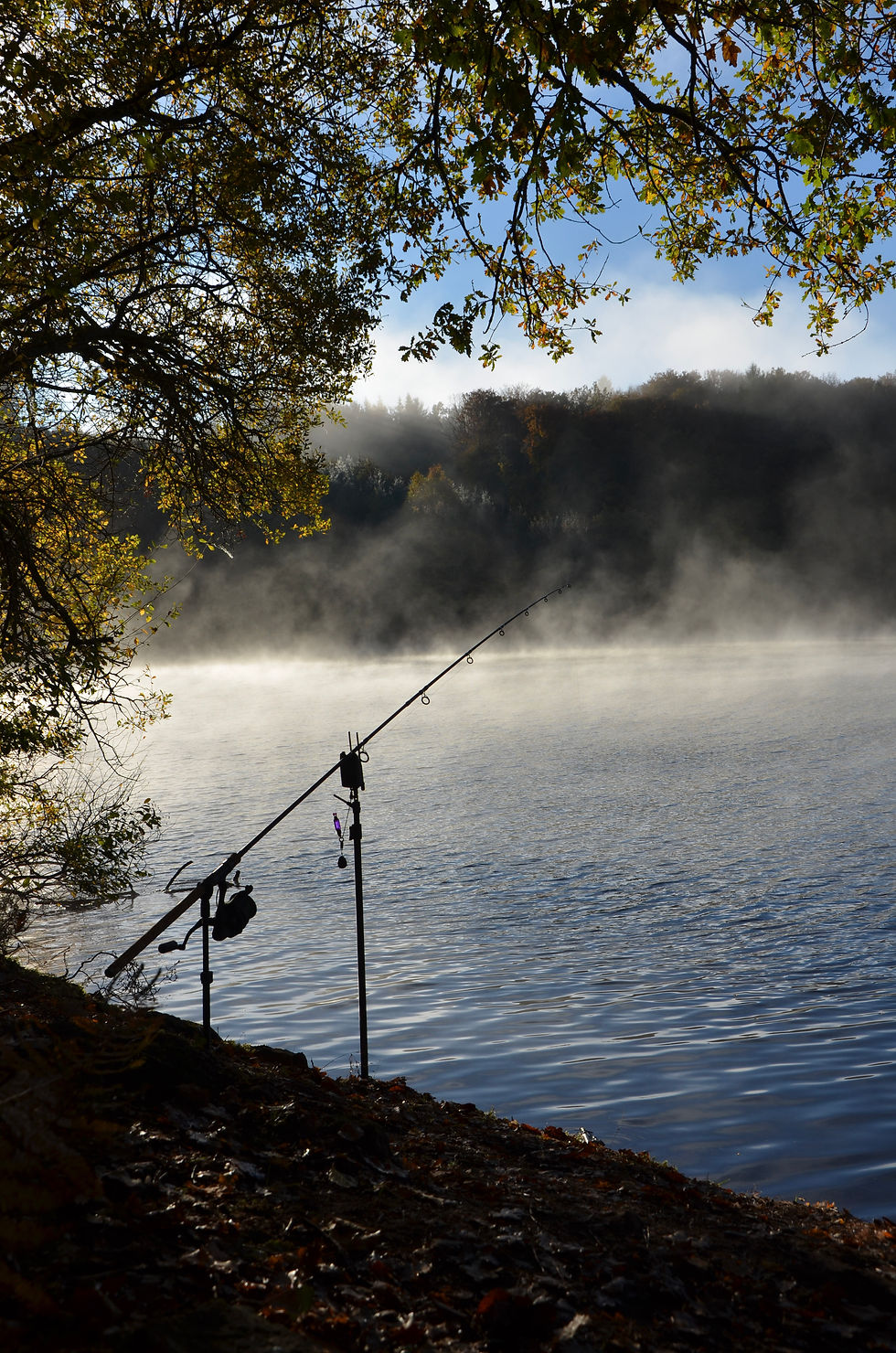
This system has allowed new areas to be opened up without disrupting coexistence with other anglers. And the feedback is clear: local carp anglers appreciate this flexibility.
📍 The precise location of all routes is available on the interactive map of the Vendée Fishing Federation website .
Clearly identified stakeholders, a coherent territory
In the Vendée region, nearly 85% of fishing areas are located on bodies of water used for drinking water production. These bodies of water are managed by Vendée Eau , and in some cases, in partnership with the Departmental Council . Thanks to fishing rights agreements signed with these managers, the Vendée Fishing Federation holds fishing rights on all the department's reservoirs, in exchange for an annual fee. The Department also owns numerous plots of land along the riverbanks.

This consistency among stakeholders represents a real opportunity to guarantee and secure access to riverbanks for anglers. However, it can also become a drawback: in the event of antisocial behavior at one site, the consequences can reverberate throughout the entire area . This is currently the case with Sensitive Natural Areas , whose regulations now prohibit nighttime activities in response to abuses (wild camping, noise pollution, etc.).
Highly frequented sites, challenges of coexistence
The lakes and rivers of the Vendée region attract a wide audience , not just anglers. Hiking trails, unspoiled landscapes, and a peaceful atmosphere are just some of the assets that also appeal to walkers, vacationers, and other nature lovers. This increasing popularity is leading to more and more problems of coexistence .
Previously less involved, some managers are beginning to take back control of their lakes due to their popularity. As a result, inappropriate fishing-related behaviors (illegal setups, noise, unauthorized parking, littering, etc.) are being more closely monitored and sometimes penalized. In the long run, these tensions could jeopardize access to fishing at certain sites.
Between success and fragility: the future of carp fishing in Vendée
With 30,000 members , nearly a third of whom practice carp fishing , the Vendée Federation boasts impressive figures. Carp fishing is one of the most popular forms of fishing there, and the department has established itself as a must-visit destination for fishing tourism – less for its record catches than for the diversity and quality of its night fishing spots.

But this success has its downsides. As soon as the first good days arrive, the riverbanks fill up. Fishermen, campers, hikers and other users share the space, sometimes without any regard for others.
The snowball effect of comfort equipment
Today, people don't just come to fish anymore. They camp , they spend their holidays there , and they often settle in as if it were their own home. Equipment has evolved accordingly: marquees, family tents, awnings, comfort amenities... But be warned: these setups are not compatible with the prefectural decrees governing night fishing in the Vendée region. These decrees authorize fishing , not wild camping .

The Federation is trying to negotiate reasonable solutions : more integrated shelters, limited sizes, respect for the environment… But visible abuses remain frequent: campfires, waste, excrement, parking in prohibited areas, combustion engines… Such violations directly endanger the future of night fishing.
Acting together to preserve our passion
Faced with this situation, the Federation is working in partnership with managers on a draft prefectural decree concerning Hunting and Wildlife Reserves, on plots classified as Sensitive Natural Areas bordering rivers and dams in the department, and as such, the taking of certain provisions which will allow fishing wardens to strengthen surveillance and be able to report offences beyond just fishing rules.

Arnaud TANGUY, the Federation's technical director, wants to be clear-headed but combative:
“We are at a turning point. If we don’t find the right direction, our night routes risk disappearing. Some have already closed under pressure from managers. We need to be disciplined to ensure this continues. Nothing is guaranteed.”
Perspectives: Innovating to preserve
Despite these tensions, the Vendée Federation is not giving up. It is seeking to diversify its offerings , particularly by developing new fishing areas away from dams . Rivers, even small ones, could accommodate fishing spots or short stretches of river with land acquisition, to broaden the range of options and reduce pressure on the most sensitive sites.
Carp fishing in the Vendée region still has a bright future, provided we work together . It is up to each of us to protect the riverbanks, respect the rules, and keep this passion alive in harmony with nature and other users.